
Your Building Is Closed. Why Is It Still Using So Much Power?
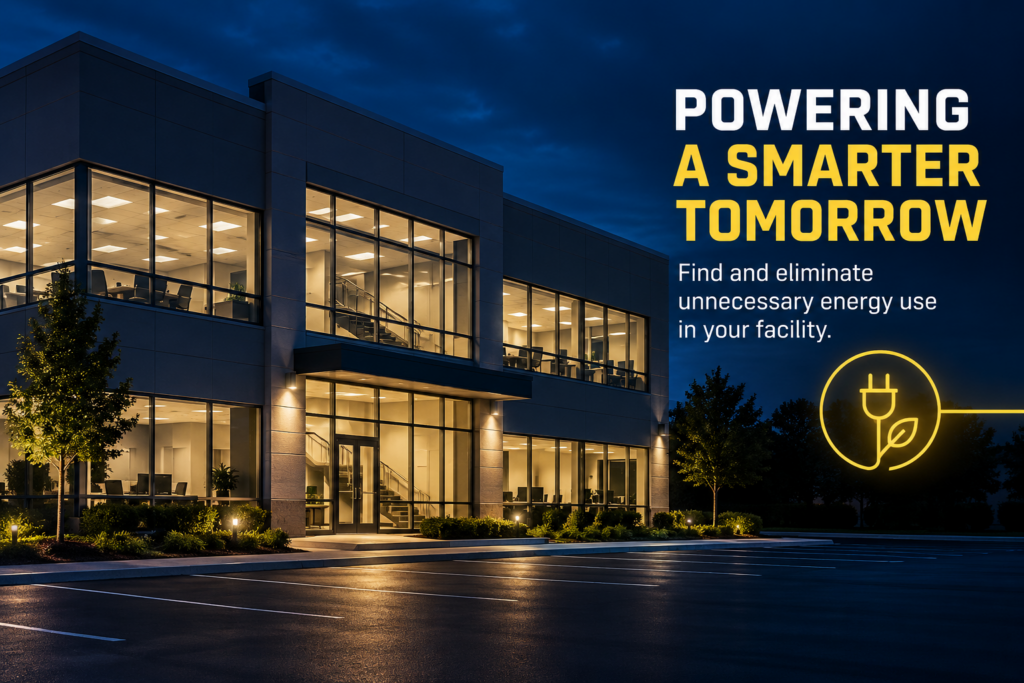
The last employee leaves. The doors are locked. The parking lot empties.
But inside your building, what is still running?
An empty conference room with the lights on. Office equipment that never enters sleep mode. A lighting schedule that still reflects business hours from two years ago.
These are worth investigating before assuming your next energy-saving move requires a major equipment investment. ENERGY STAR recommends checking facilities after hours to identify equipment operating when it should not be—a practical starting point for uncovering unnecessary energy use.
For business owners and facility managers, the question is simple: Are you paying to power your business—or to power things your business is not using?
Separate Essential Power From Unnecessary Power
An after-hours energy review should not become a campaign to turn everything off.
First, identify the systems your facility needs to keep operating. Protect refrigeration, security systems, servers, life-safety equipment, required ventilation, and other critical loads from any blanket shutdown plan. Coordinate decisions with the people responsible for those systems.
Then focus on the remaining equipment. Ask what needs to stay on, what can enter a lower-power mode, and what could follow a more appropriate schedule.
Think of a hypothetical distribution facility: refrigeration and security may need continuous power, while an unused training room may not need full lighting all weekend. Treating both spaces the same would miss the point.
The goal is not the lowest possible electricity use. It is electricity use that matches the building’s actual needs.
Look Beyond the Monthly Bill
A useful next step is to ask your utility or facility team whether detailed meter data is available. Time-series electricity data can reveal consumption patterns and unusual behavior that warrant investigation. It provides a starting point for asking when energy is being used, not simply how much.
Compare those patterns with your operating schedule. Does consumption decline after closing? What happens on a weekend without production? Does the building appear to start its day much earlier than employees do?
Treat unexpected patterns as questions, not proof of waste. An overnight load could reflect a legitimate cleaning shift, scheduled charging, or a process that cannot stop.
Pair the data with a walk-through involving someone who understands the facility. Observe which areas are occupied, which lights are on, and which equipment is running. Record what you find rather than making unplanned changes. ENERGY STAR specifically identifies nighttime audits and equipment scheduling reviews as low-cost energy-management measures.
Give Lighting a Schedule That Fits the Space
Instead of asking only whether your lighting is efficient, ask whether it is needed at that moment.
LED upgrades can reduce the electricity used for lighting, but equipment selection and operating hours are separate considerations. An efficient fixture still consumes electricity when it is on.
Review conference rooms, storage areas, private offices, and other spaces with intermittent use. Occupancy sensors can help reduce unnecessary lighting in suitable applications, but correct placement matters. A sensor blocked by furniture or poorly positioned for the space may not operate as intended.
Also consider whether one employee working late needs an entire floor illuminated. Ask your electrical contractor whether lighting zones and controls could better match how the space is used, while preserving appropriate visibility, access, and safety.
MC Power offers custom lighting controls, including timed lighting and sensor-based solutions, with designs that consider the space and its lighting requirements.
Small Loads Can Add Up to a Meaningful Expense
Consider this hypothetical example.
A facility identifies a combined 10 kilowatts of unnecessary electrical load that could be eliminated for 12 hours per day across 260 days each year.
The avoidable energy use would be:
10 kW × 12 hours × 260 days = 31,200 kWh per year
At an assumed electricity energy rate of $0.12 per kWh, that equals:
31,200 kWh × $0.12 = $3,744 per year
That is not an estimate for your facility or a promised result. It illustrates how operating hours affect energy costs. The calculation assumes the entire identified load can be eliminated during those hours and excludes demand charges, fixed charges, taxes, and implementation costs.
The important lesson is not the specific dollar amount. It is that a modest load deserves attention when it operates for thousands of unnecessary hours.
Start With Better Habits Before Bigger Purchases
Not every finding needs a construction project.
For office equipment, review available power-management and sleep settings with your IT team. ENERGY STAR recommends using these features on computers, monitors, printers, and multifunction devices to reduce consumption during inactive periods. Preserve any settings needed for updates, remote access, or other business requirements.
For building controls, review existing schedules before assuming the equipment must be replaced. A temporary override may have become permanent, or a schedule may no longer reflect current occupancy. Document approved changes and periodically check that the intended settings remain in place.
Make this a shared effort rather than a search for someone to blame. ENERGY STAR’s Energy Treasure Hunt approach brings employees together to identify and quantify energy-saving opportunities.
Give each approved improvement an owner. Record what changed, why it changed, and how you will check the result. That creates a repeatable process instead of a one-time cleanup.
Make Your Energy Use Work for Your Business
Before approving another upgrade, ask a practical question:
Do we understand what our building is doing when we are not here?
Use the answer to develop priorities. Separate operational changes from equipment improvements, protect essential systems, and evaluate the cost and expected benefit of each proposed project.
At MC Power Companies, we provide commercial and industrial electrical solutions that include indoor and outdoor lighting, custom lighting controls, power distribution, and design-build services. These capabilities support improvements tailored to how a facility operates—not just the equipment it contains.
Contact MC Power to discuss lighting and electrical improvements that align your facility’s energy use with your business needs.